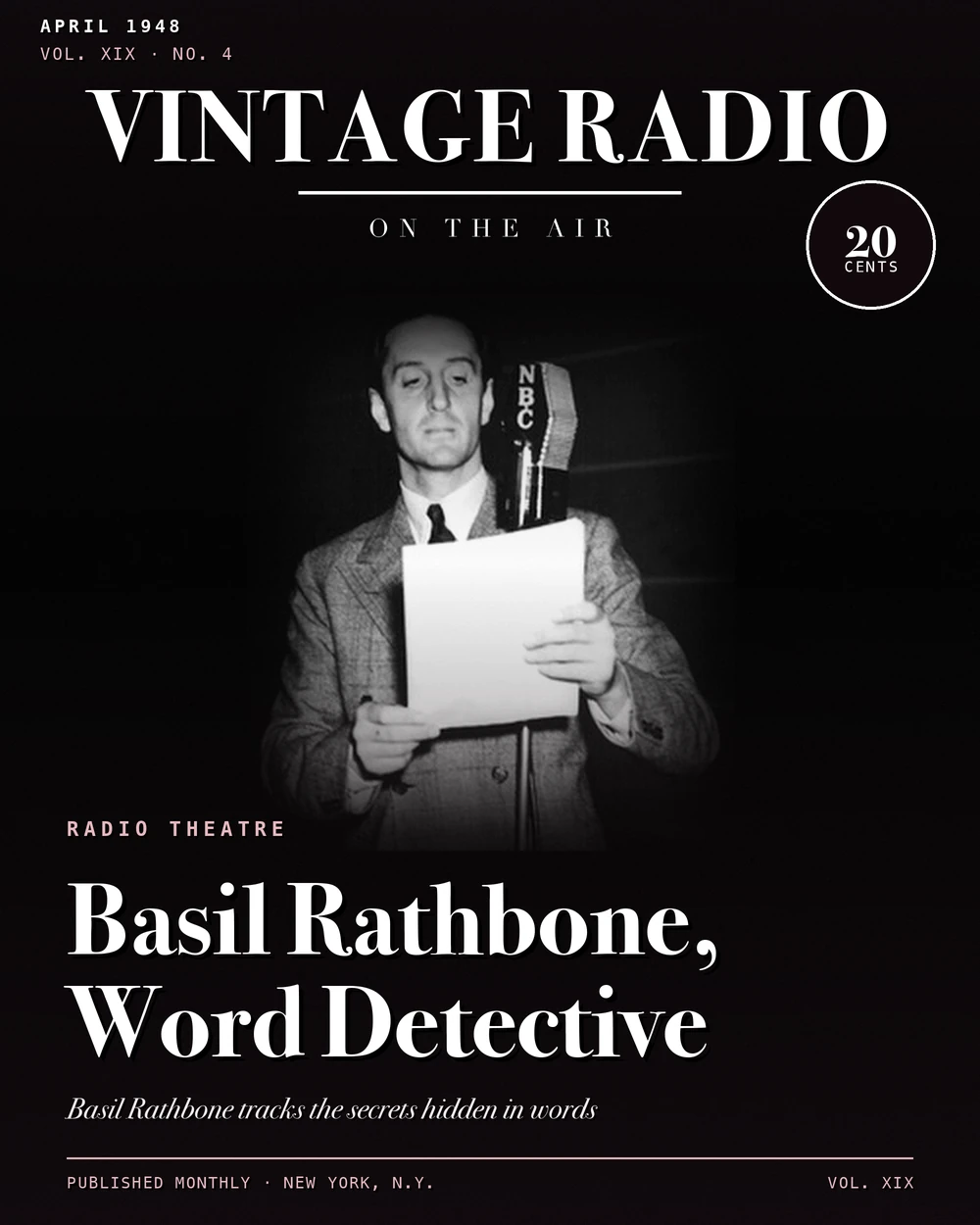
Basil Rathbone – Word Detective
A Voice Built for This Kind of Thing
Basil Rathbone spent decades on stage and screen before arriving at Word Detective, and the program sounds exactly like what it was: a man with an exceptional theatrical instrument who genuinely loved the English language, turning that love into two or three minutes of radio. Each episode took a single word or expression — "tangerine," say, or "to get one's goat" — traced it back to its origins, worked in some historical color and a well-placed quip, and then, in a signature bit of stagecraft, Rathbone typed the word on his Underwood typewriter before revealing it to the audience. It was a small, precise format, and it suited him perfectly.
The show was designed for local-station syndication, distributed on 12-inch 33⅓ RPM transcription discs rather than broadcast on a single network. A Discogs listing dates one known broadcast week to October 19, 1959, and one online source has placed the series in 1959–1960, though no precise broadcast dates are embedded in the surviving audio itself. One OTR blog put it plainly: "from all indications these were done in the 1950s but there are no dates available anywhere." The transcription disc format — with standard openings and closings on a personalized station identification disc — confirms the show was built for flexible local pickup across whatever markets wanted it.
Rathbone Beyond Sherlock Holmes
Most people who tuned in to Word Detective would have known Rathbone first as Sherlock Holmes — a role he played in fourteen Hollywood films between 1939 and 1946, always opposite Nigel Bruce as Dr. Watson, and which he also brought to radio beginning in October 1939 with The New Adventures of Sherlock Holmes. But Rathbone's career ran considerably wider than that. He trained as a Shakespearean stage actor in Britain and appeared in more than seventy films, earning two Academy Award nominations along the way.
After stepping away from the Holmes role in 1946, he developed a one-man stage show called An Evening with Basil Rathbone, in which he recited poetry and Shakespeare for live audiences. That show illuminates exactly what Word Detective drew on — a cultivated, literary sensibility that could hold a room on the strength of language alone. He won a Tony in 1948 for Best Actor in a Play, for his portrayal of Dr. Austin Sloper in the original Broadway production of The Heiress, and he holds three stars on the Hollywood Walk of Fame, covering film, radio, and television — a spread that reflects how thoroughly he worked across every medium available to him.
His own feelings about radio were clear. He was quoted as saying, "Radio is unquestionably a superior medium to television because it makes us use our imagination" — which makes Word Detective feel less like a side project and more like work he took seriously.
What Survived
The catalog holds five episodes: "Melba Toast," "Stoic," "Tangerine," "The Saxophone," and "To Get One's Goat." Each runs approximately two to three minutes, making the full five a short but complete listening experience. The brevity was the point — Word Detective was a featurette in the tradition of other short-form educational and curiosity programs of the era, sitting alongside Incredible But True, Ripley's One Minute Shorts, and Ellery Queen Minute Mysteries. It ran only briefly before disappearing from the schedules, which accounts for how little documentation surrounds it.
The five surviving titles give a fair sense of the show's range: an expression rooted in idiom ("to get one's goat"), a word borrowed from a person's name ("melba toast"), a philosophical term ("stoic"), a fruit whose name carries geographical history ("tangerine"), and an instrument with an inventor ("the saxophone"). Rathbone moved easily across all of them, and the format — anecdote, etymology, quip, typewriter — gave each one a consistent shape without making them feel repetitive.